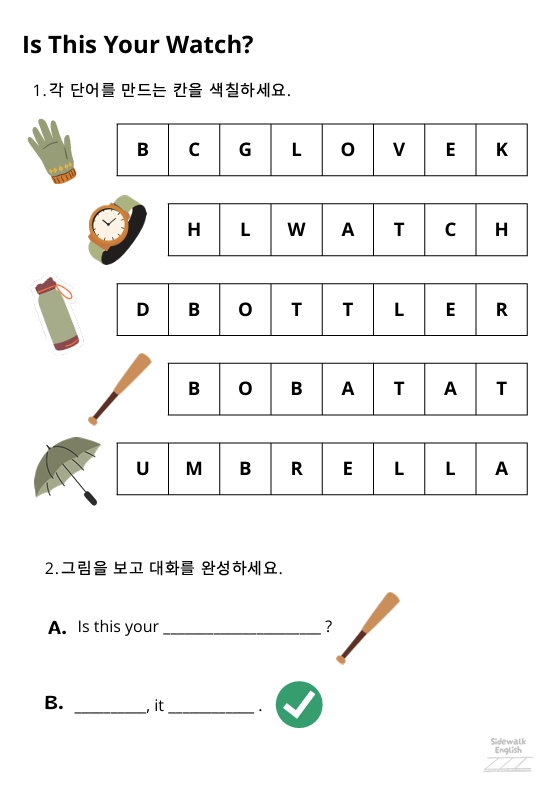
A worksheet for young EFL students to practice possessives, basic adjectives (short, long, big, small), and objects in English such as watch, umbrella, glove, bat, and bottle.
This took my 4th grade EFL class of 22 students about 10 minutes to complete.
This worksheet is designed as a half sheet on A4 paper, so you will need to cut the pages in half.
It’s double-sided, so make sure when you print, it’s set to two-sided, flip on the short edge!
You can download the student version and answer key below.
This is a classic game in the EFL community, so it’s been redone countless times, but my students LOVE this game, so I made my own materials for it.
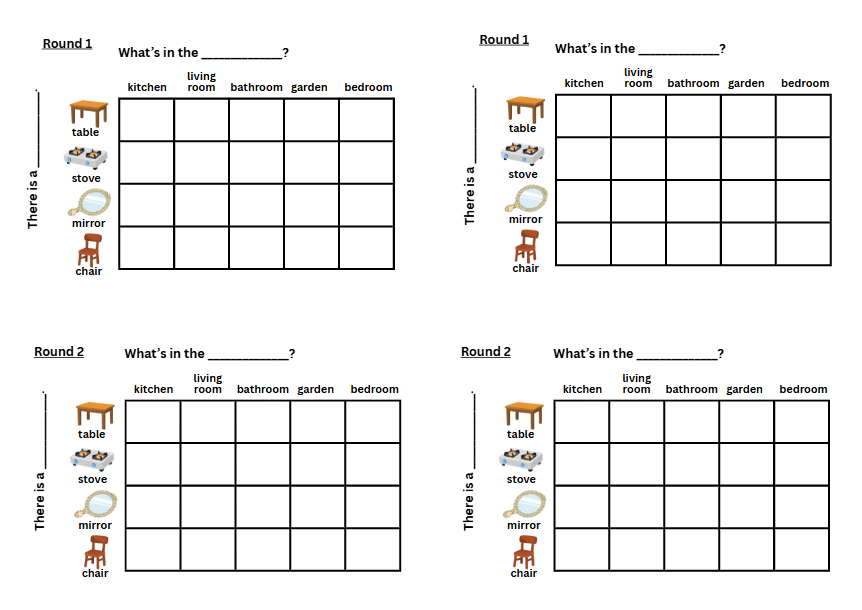
Battle Ninjas is somewhat similar to the board game classic, Battleship. Students will receive an activity sheet with a grid, and they must draw some number of ninjas in the boxes of the grid.
The columns and rows of the grid are labeled with vocabulary words or images, so to choose a box, a student must specify which box using the target vocabulary. If the other students have a ninja in the chosen box, they cross that ninja out.
In my class, the goal is to end the game with as many ninjas alive as possible, but you can play with the opposite goal, where students try to cross out as many ninjas as possible.
In my version, one student chooses a column by asking a question, and another chooses a row by answering the question. This way, as many students can speak as possible and the result is more randomized.
This version of the game sheet is designed to teach target vocabulary related to rooms and objects found in a house. It is designed to be printed doubled sided on A4 paper and cut into quarters, so you can play 2 rounds while saving as much paper as possible.
I play 2 rounds. In the first round, students win by having the most number of ninjas alive at the end of the game. In the second round, I join in with my own activity sheet, and students try to beat the teacher by having more ninjas alive than me at the end.
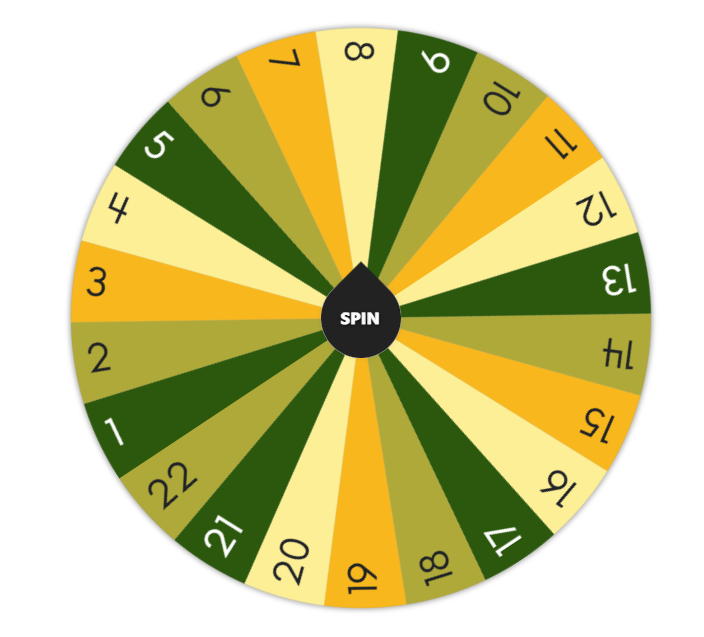
To play, I pick students using this random number generator spin wheel. The students have class numbers, so when they see their own number show on the screen, they will know it’s their turn.
Students are so excited by the suspense of watching the wheel spin to see who will get picked. I really like this particular site for this because you can remove the number that was chosen so no student goes twice and everyone gets a turn. There is also a fun confetti animation when a number is chosen.
When played with 2 rounds and the spin wheel, this game takes my class of 22 students about 20-25 minutes.
You can download my instructions PPT and my activity sheet for this lesson as an editable PPT so you can adjust the game for your own lessons.
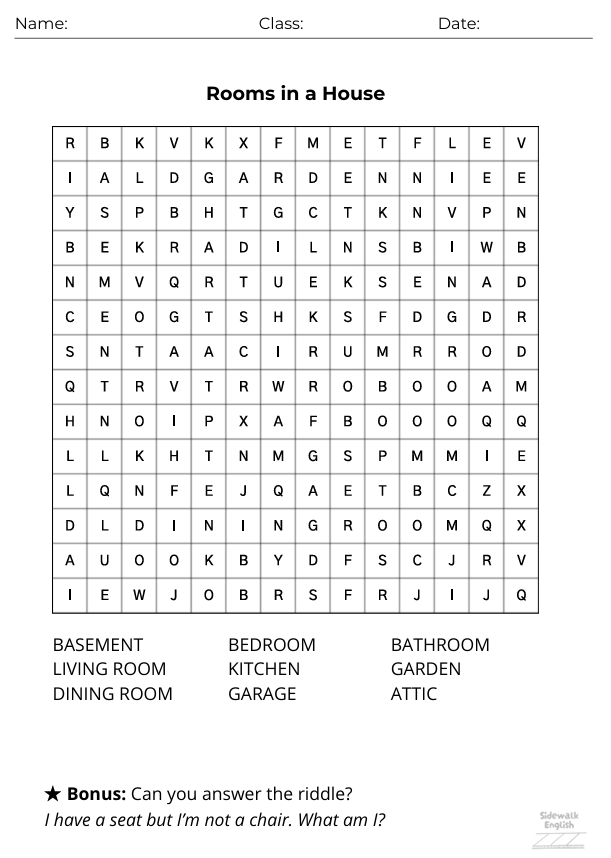
This EFL/ESL English worksheet helps students review rooms in a house. It also includes a few less common vocabulary words such as garage, attic, basement, and dining room, which you may have to define depending on your students’ English level.
The front is a simple word search. There is a bonus question riddle meant to be optional for students who finish early and need something else to focus on.
The back has some fill in the missing letter spelling exercises, then a maze, where you collect letters and unscramble to reveal a hidden word related to the lesson.
My Grade 5 class of 22 students took about 15 minutes on this. A few students finished early and tried solving the riddle too!
This worksheet is designed as a half sheet on double-sided A4 paper, so you will have to cut the pages in half. Student versions with English only and Korean translations are included below, along with an answer key.
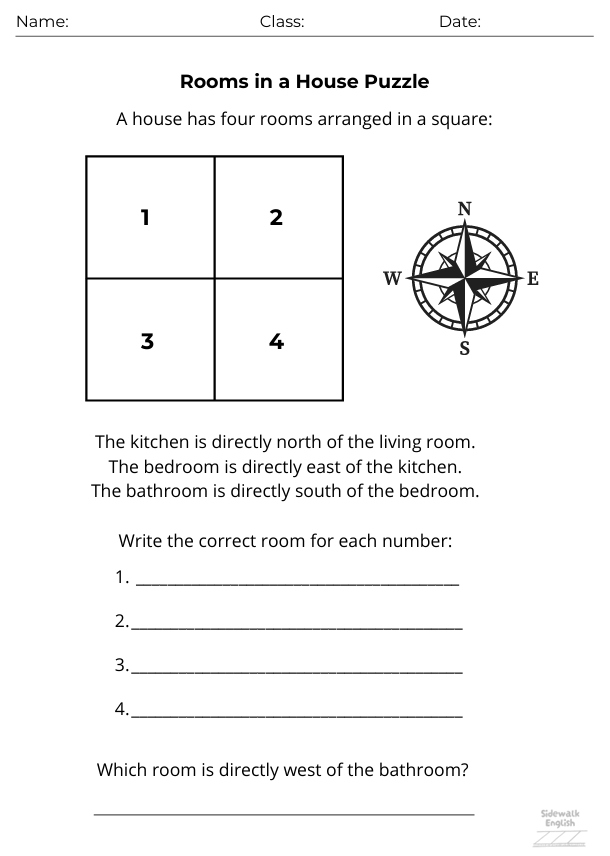
This worksheet is to help students learn rooms in a house such as bathroom, living room, kitchen, bedroom. The front side is a mini logic puzzle, where students write where is each is in relation to the other according to hints given using cardinal directions.
Depending on your students’ English levels, you may need to review the meanings of North, South, East, and West, as well as the definition of “directly” as used in this context.
This exercise requires students to use their brains a little more beyond just repeating and copying English vocabulary, which is great!
The back also features an Odd One Out exercise where students identify the word that doesn’t quite fit in, and it has some extra vocabulary (basement, garage, attic) in number 4. You can define the words or skip this question. Odd One Out is followed by a labeling exercise where students write the name of the room the object pictured would be found in.
Bonus Question Notes
The bottom bonus section is meant to be optional. It is there to engage the students who finish a bit faster and need something extra to focus on.
Note that for the bonus question, the Korean translated version leaves the word “room” as is in English, because the riddle does not make as much sense when fully translated to Korean. This also serves as a small hint to the students!
This worksheet is aligned with the YBM (Kim) Elementary Grade 5 curriculum, Lesson 6 “What’s In The Kitchen?” It will be better to use with more advanced students.
It is designed as a double-sided half page on A4 paper, so you will need to cut the pages in half, and set your printer to print double sided (flip on the short edge). Student versions in English only and with Korean directions and the answer key are below.
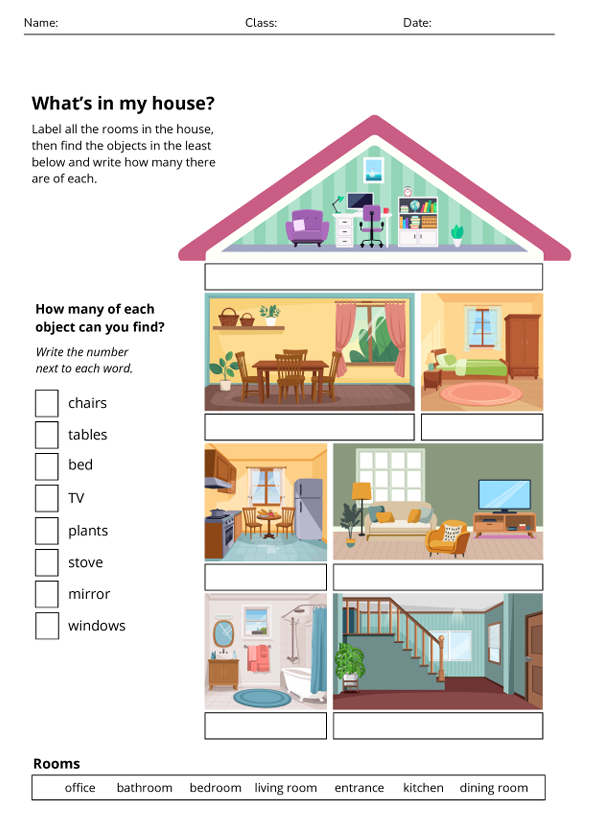
This ESL English worksheet to teaches about rooms and objects in a house. It has a front and back, and it includes a few different exercises. First, students must recognize and label rooms in the house, then recognize and count how many of each listed object they see. Word bank is included for students who need help with spelling.
The back has a crossword puzzle with simple hints to each room. Then students, must fill in the blanks to complete the sentences below using the answers from the crossword puzzle.
If you want, you could separate the 2 pages or use them across 2 different class periods. The front works well as an intro to the lesson, while I find that crosswords are better for review once the students are more familiar with the new vocabulary.
This takes my 5th grade class of 22 students about 25 minutes to complete. It aligns with the YBM (Kim) Grade 5 curriculum, lesson 6 “What’s in the Kitchen?”
The worksheet is designed to be printed double-sided in color, on A4 paper. You can downloaded the student version and answer key as free PDFs below.
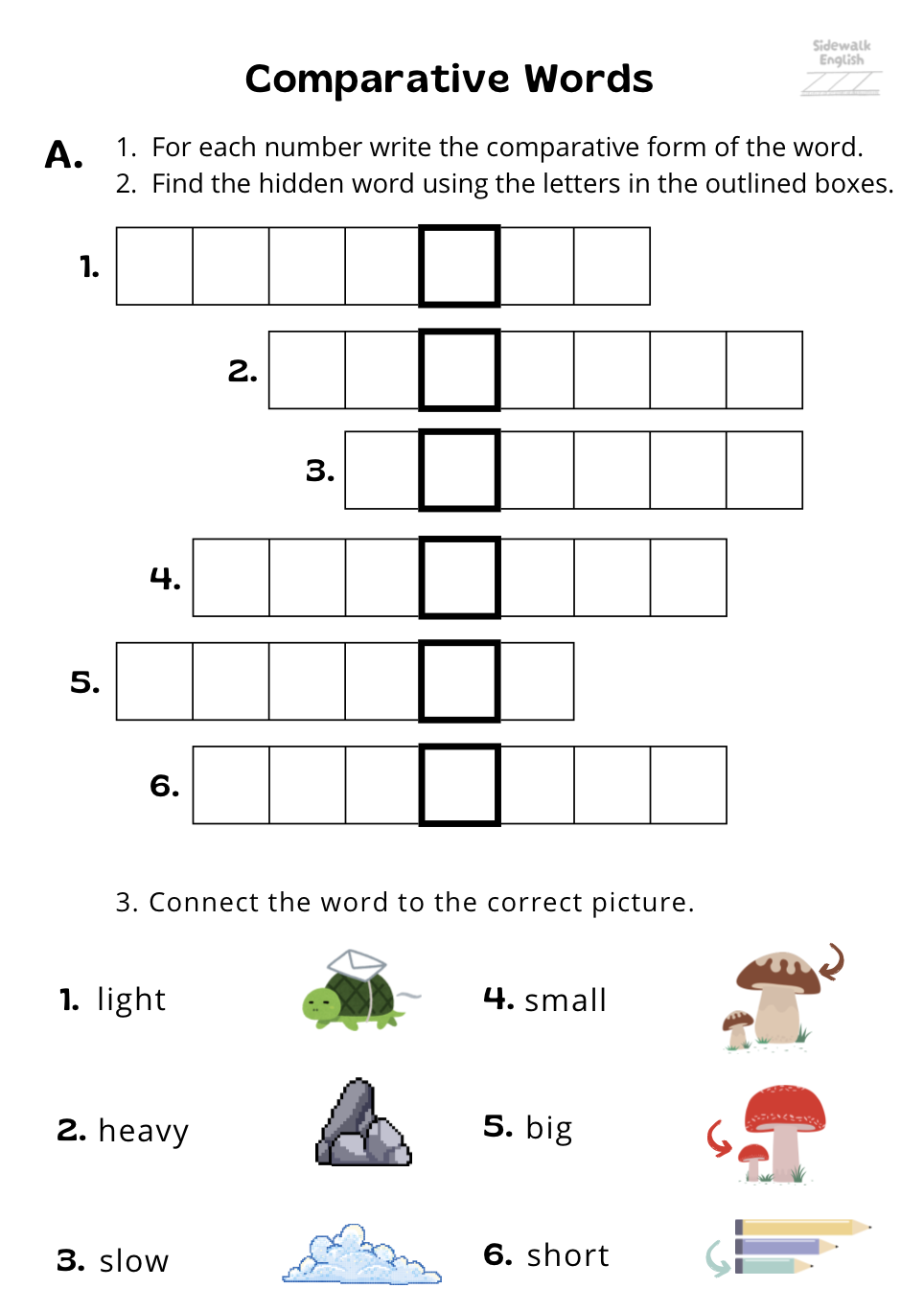
This comparatives worksheet for EFL/ESL classes has a lot of various different exercises to keep students engaged while studying.
The first part A. is a variation of a crossword puzzle, where students must convert the word of the corresponding number into the comparative form (1. light → lighter), then find the hidden word spelled out vertically in the thickly outlined boxes.
The words used in the crossword are also part of a activity where students connect the meaning with the picture, so this first part of the worksheet has three separate steps to complete that are all interconnected.
On the back in part B., students practice spelling by filling in the appropriate vowels to complete the sentence (some of my students especially have some trouble with this). Depending on English level and the curriculum you follow, students may not know the words “rock” and “cloud,” so remember to point those out and define them.
Part C. is a mini reading comprehension exercise to drill the words “younger” versus “older.”
Finally, the last part D. calls back to the first exercise in part A. Students must fill in the blank using the hidden word from part A, then solve the riddle. This riddle is just here for the fast students who finish early and need something to focus on for a few minutes, so I recommend making it optional!
This worksheet aligns with the YBM Grade 6 curriculum, Lesson 6 “My Ice Cream is Bigger Than Yours.” It takes my class of 23 students about 20-25 minutes to complete.
This worksheet is designed as a double-sided half sheet on A4 paper, so you’ll have to cut the pages in half. I’ve included a version with Korean instructions first, followed by the English only version, and finally, the answer key.
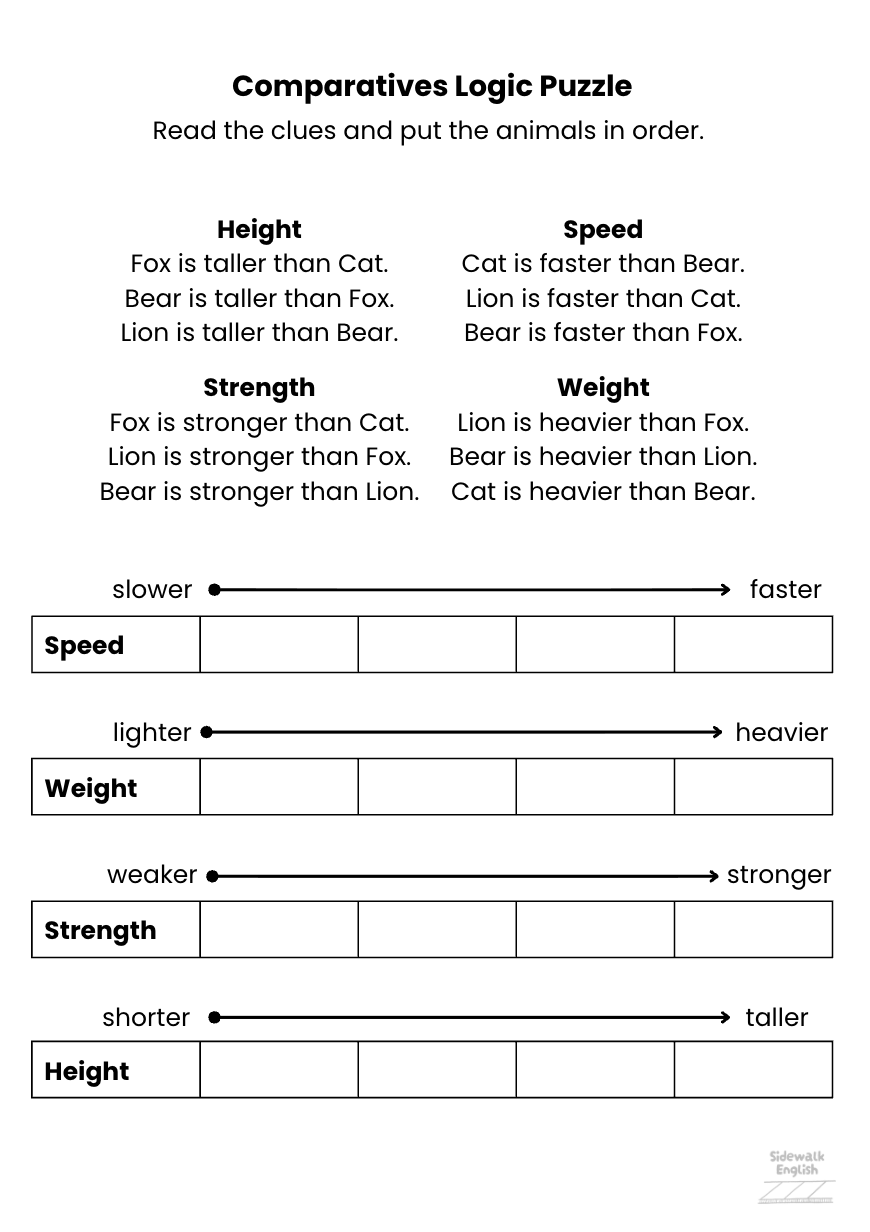
This logic puzzle is perfect for teaching students comparatives!
Students must use the clues to fill out the chart, then use the chart to answer the questions on the back.
I used this activity with my 6th grade EFL students in Korea for the YBM Lesson 6 “My Ice Cream is Bigger Than Yours.” We spent about 15 minutes on it in my class of 23 students.
I’ve included a version with Korean translations and an English only version along with the answer key below. This is designed as a half sheet on A4 paper, so you’ll have to cut the pages in half.